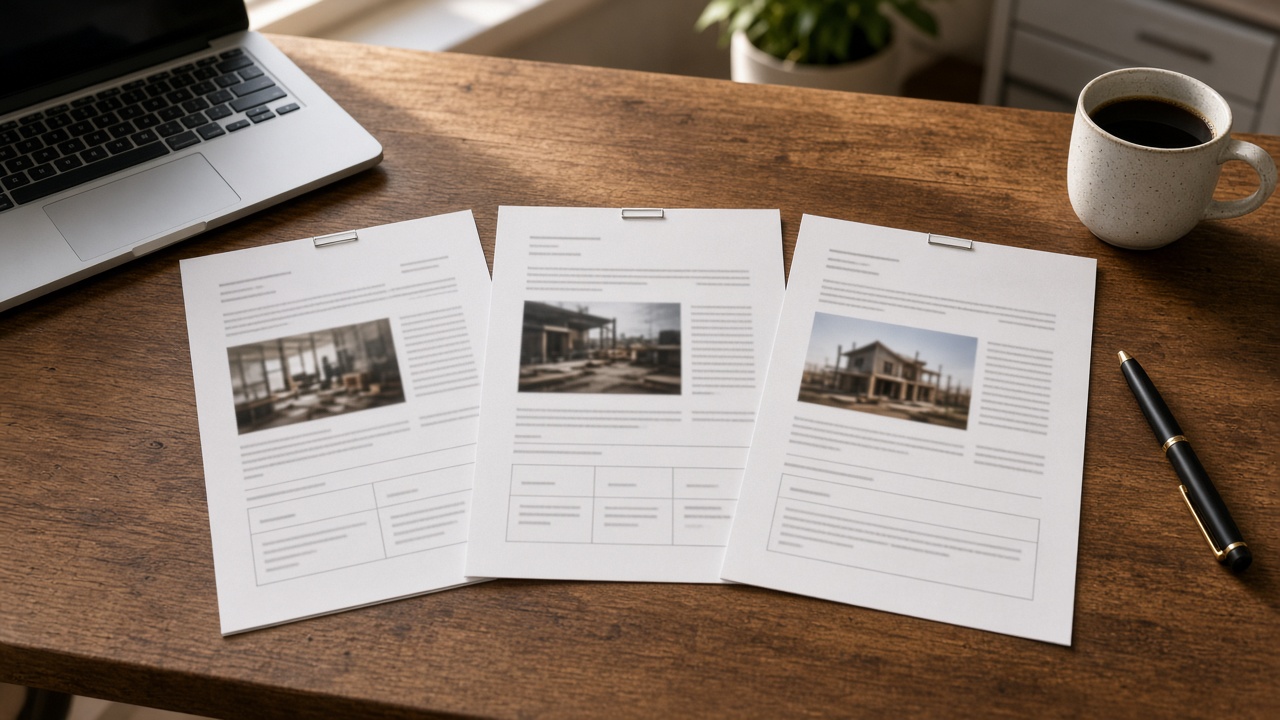
"Get three bids" is the advice everyone gives. The California Contractors State License Board (CSLB) gives it too, and recommends getting at least three bids on a project (CSLB guidance). The part people skip is how to make the three bids comparable. Otherwise you end up comparing three different jobs.
Step 1: Decide what you're actually asking for
Before you contact anyone, write down: - the rooms or areas involved and what you want done in each, - what you want left alone, - who supplies materials and fixtures (you, or the contractor), - your target start window and anything that limits it (HOA rules, permits, occupied home).
One page is enough. This becomes the scope every contractor prices. Our guide to writing a scope that gets comparable bids has a checklist.
Step 2: Find contractors worth asking
- Check the license first. Look up each contractor on the CSLB site before you talk price. Our CSLB license check guide shows what to look at. In California, work over $1,000 in combined labor and materials requires a licensed contractor.
- Ask neighbors and friends who've done similar work in your part of LA, and ask what went wrong, not only what went right.
- Use a bidding site. On Bidroom you post the scope once and contractors send bids to the same page. Wherever you find them, the same rules apply.
- Match the trade and the size. A firm that does ground-up ADUs may not want a bathroom refresh, and vice versa. Our guide to finding reliable subcontractors in LA covers the trade side.
Step 3: Send everyone the same package
Send the same scope, the same plans or photos, and the same deadline. If one contractor asks a question that changes the scope, send the answer to everyone. That is what keeps the bids comparable.
Step 4: Ask for the same things back
Ask each contractor for: - a line-item price (or at least labor, materials and permits separately), - what's included and what's excluded, - a start window and an estimated duration, - a payment schedule, - their license number and proof of workers' compensation and liability insurance.
Step 5: Compare scope first, price second
Lay the three bids side by side. If one is much lower, check what it leaves out before you get excited. Scaffolding, permits, haul-away, finish materials and cleanup are common gaps. A bid that looks cheap because the scope is shorter isn't cheap.
Step 6: Check the payment terms
CSLB advises against paying more than 10% of the contract price or $1,000, whichever is less, as a down payment on a home-improvement contract, and against paying in cash or paying ahead of completed work (CSLB). Any contractor asking for a large deposit up front deserves a question.
Step 7: Put it in writing
Pick the bid you trust, then get a written contract covering scope, materials, price, schedule, cleanup and how changes are handled. Keep every change in writing.
If you only get two bids
If your project is small or specialized, two good bids can be enough. The point of the third one is a reality check on scope and price, not a ritual. What matters is that the bids are for the same work, from licensed contractors you've verified.
Ready to try it? You can post your project and compare the bids that come in.
What Would Your Project Cost?
Get an instant cost range for your ZIP code and see licensed contractors near you. Free, no signup required.
Get My Free EstimateGet contractor pricing for your area
Enter your email and we'll send you cost data and licensed contractor matches near you.