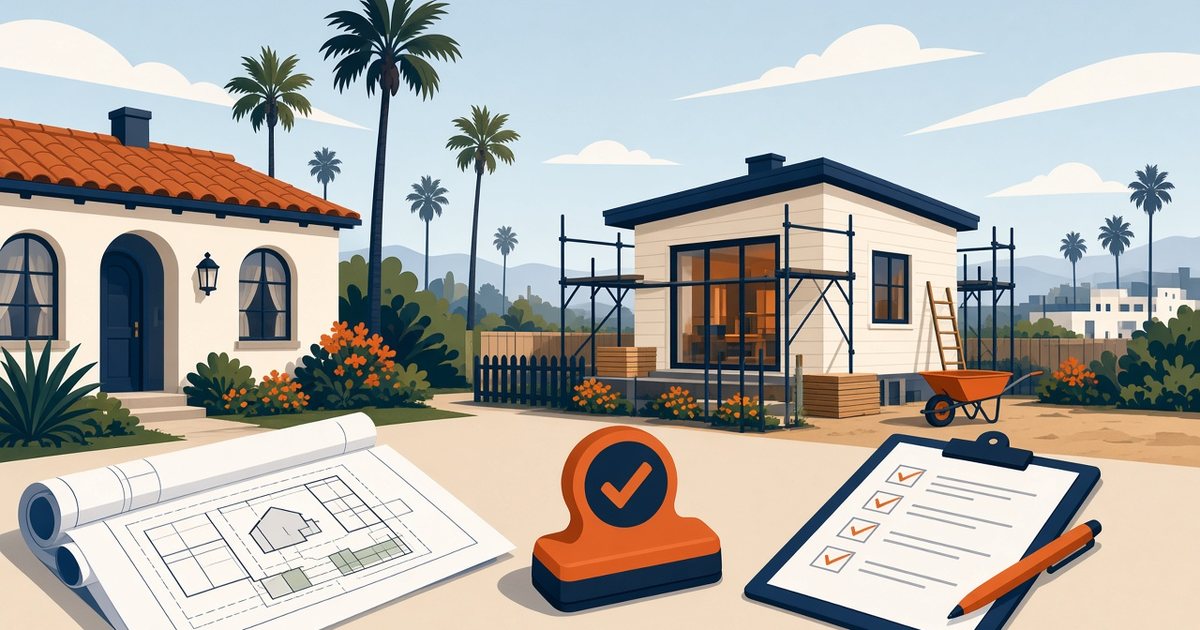
Most owners picture "get a permit, hire a contractor, start." In practice the order has more steps and some of them overlap. This is the sequence for a typical addition or ADU in the City of Los Angeles, which is permitted by LADBS. If your lot is in another city or unincorporated LA County, the agency and the details differ.
1. Check what you can build
Look up the property's zoning and overlays before you pay for design. Our LA ADU permit guide covers the lookup and what changes by lot.
2. Get plans
You can use a custom design, or one of LADBS's pre-approved ADU standard plans. A standard plan has already been reviewed for the building design, so plan check focuses on the site: placement, utilities and the foundation for your soil. LADBS notes that many listed plans have expired, so check which are currently approved.
3. Submit for plan check
Under state law, the city must tell you whether your ADU application is complete within 15 business days, and then approve or deny a complete application within 60 days. The clock runs on a complete application, so missing documents or slow answers to corrections cost you time (Gov. Code §66317). Third-party permit sites estimate roughly 2–3 weeks for a clean standard-plan application and 4–10 weeks for custom plans. Those are estimates, not promises. Your actual time depends on the lot and how fast you answer corrections.
4. Answer corrections quickly
Plan check usually produces correction notes. The projects that move fastest answer them in days, not weeks.
5. When to ask contractors for prices
You don't have to wait for the permit to start collecting bids. Many owners ask for bids once plans are complete enough to price, often while plan check is running, then hold the final contract until the permit is issued and the scope is final. Contractors price better when they can see the approved or near-final plans, so ask each one what set they're pricing. For how to run this, see how to get three bids and how to write the scope.
6. Choose a contractor and sign a contract
Check the license (how to), compare scope and exclusions, and put everything in a written contract. California limits a home-improvement down payment to 10% of the price or $1,000, whichever is less (B&P Code §7159).
7. Permit issued, work starts
Fees are paid, the permit is issued and the first inspections get scheduled. After that the project runs through its inspection sequence: foundation, framing, rough utilities, insulation, drywall and final. Subcontract work such as stucco, HVAC, electrical and roofing usually gets bid and scheduled around those inspections. Subcontractors looking for this kind of work can browse open LA jobs on Bidroom.
What actually causes delays
- Incomplete plans or missing documents at submittal.
- Slow replies to corrections.
- Surprises on the lot (soil, utilities, access) that force a redesign.
- Starting the bidding process without a final scope, so the price changes later.
If you want to see how a real mid-project job gets divided into trades, our Mid-City remodel guide walks through one.
What Would Your Project Cost?
Get an instant cost range for your ZIP code and see licensed contractors near you. Free, no signup required.
Get My Free EstimateGet contractor pricing for your area
Enter your email and we'll send you cost data and licensed contractor matches near you.