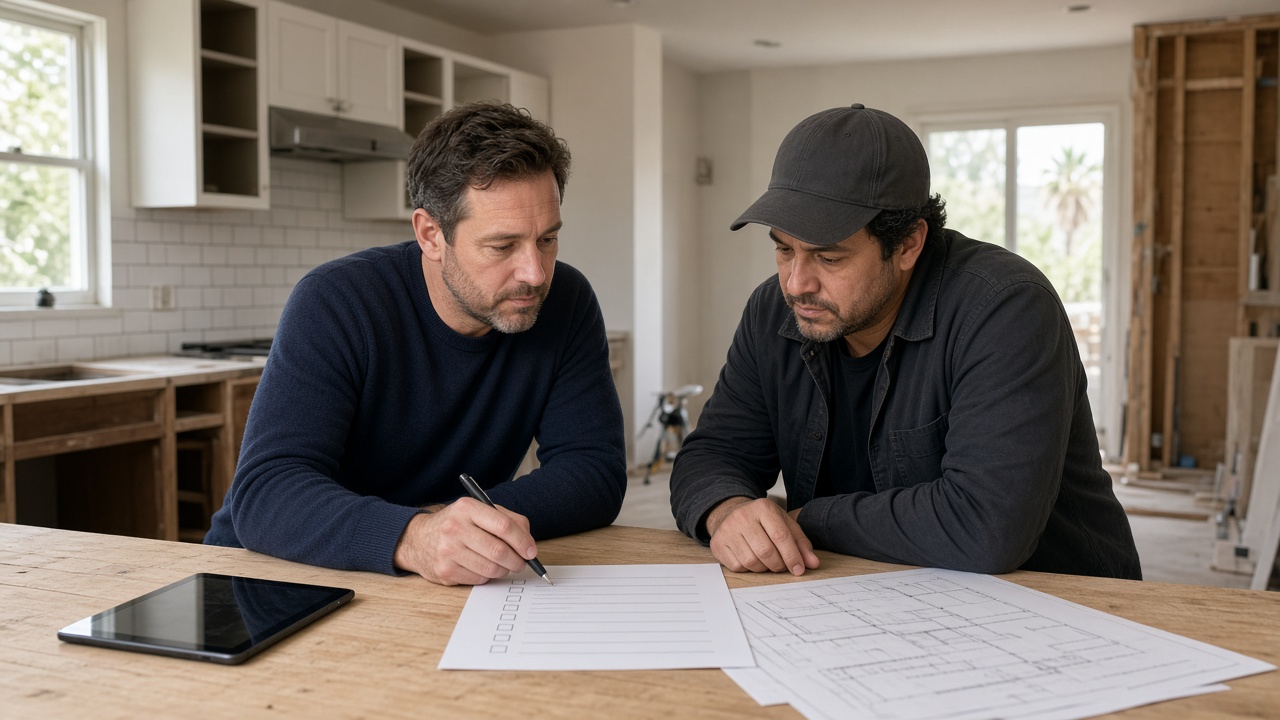
You send the same request to three contractors and get three prices that don't look related. Before you decide someone is padding or lowballing, check the more common cause: they weren't pricing the same job.
Where bids actually diverge
- What's included. One contractor includes scaffolding, another assumes you'll provide it.
- What's excluded. The bid that omits permits, haul-away or cleanup looks cheaper.
- Materials. Allowances differ: one prices builder-grade, another prices what you described in a photo.
- Unknowns. Some contractors add a contingency; some price only what they can see.
- Sequence. A trade that works after another trade priced the dependency differently.
Use inclusions and exclusions on purpose
Good scopes say what is not in the job. Here are real examples of how that looks from open jobs on Bidroom:
- A stucco job in Mid-Wilshire lists metal lath, weather barrier, three coats and tie-ins at the new and existing walls, and then states scaffolding, roofing, windows and paint are excluded. A bidder knows exactly where their work stops.
- An HVAC job lists two furnaces and two ducted splits in the house plus installing and warranting owner-supplied equipment in the ADU, and says gas piping and electrical beyond the disconnect are excluded, because other trades handle them.
- A framing job in Mid-City says it's labor only and that a material takeoff is available, so a bidder doesn't have to guess who buys the lumber.
You can see these on the live job pages (for example the HVAC job and the framing job) if you're open at the time you read this.
A one-page scope checklist
- Where: neighborhood or address, access notes (narrow gate, stairs, parking).
- What: each area and what changes in it, one line per item.
- Not included: things the contractor should not price.
- Who supplies what: materials, fixtures, equipment.
- Allowances: for items you haven't chosen yet, state a dollar allowance or ask contractors to list their assumption.
- Plans and documents: the exact set everyone prices from.
- Permits and inspections: who pulls the permit, who schedules inspections.
- Schedule: target start, what must happen first, any deadline.
- Site conditions: occupied home, HOA hours, pets.
- Bid format: line items, license number, insurance proof, payment schedule.
Handling the outlier
If one bid is far below the others, ask that contractor to walk through their scope line by line. If they've left something out, you can decide whether to add it. If they haven't, you may have found the right contractor. If one bid is far above, ask what's driving it; a contractor who explains it clearly is usually worth listening to.
Keep the answers in one place
Whatever channel you use, send clarifying answers to all bidders. On Bidroom the scope and the plans live on one job page that every bidder sees, which makes this automatic. For the sequence that comes before bids, see the permit-to-contractor timeline, and for getting the bids themselves, how to get three bids.
What Would Your Project Cost?
Get an instant cost range for your ZIP code and see licensed contractors near you. Free, no signup required.
Get My Free EstimateGet contractor pricing for your area
Enter your email and we'll send you cost data and licensed contractor matches near you.