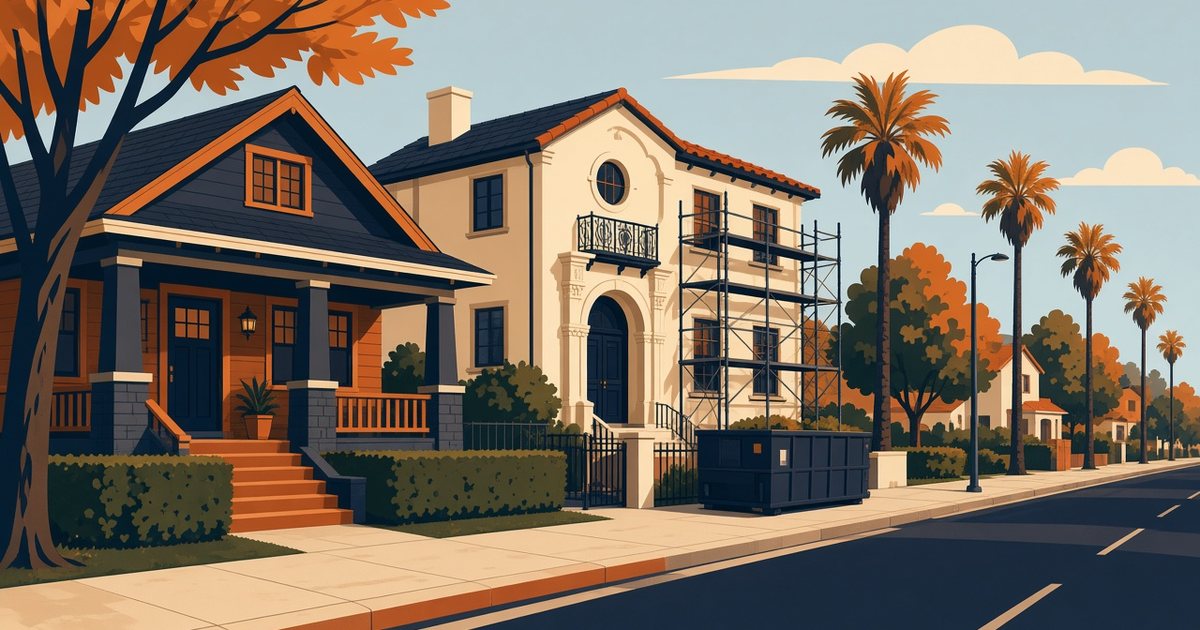
Mid-City and the neighborhoods around it, including Brookside, Victoria Park, La Fayette Square, Wellington Square, Country Club Park and the Miracle Mile, have some of LA's best 1910s to 1930s housing: Craftsman, Spanish Colonial Revival, Tudor and Mediterranean homes on real lots. They're also full of surprises when you open the walls, and many blocks nearby sit inside Historic Preservation Overlay Zones (HPOZs), which add a review step most owners don't plan for.
Here's what to check before you design, bid or build.
Step 1: Check for an HPOZ or other overlay
Look up your address in ZIMAS and look under "Planning and Zoning." Several nearby neighborhoods are HPOZs, including Country Club Park, La Fayette Square, Harvard Heights, Western Heights, Wilshire Park, Windsor Village, Oxford Square, Miracle Mile and Carthay Circle. Brookside, Victoria Park and Wellington Square aren't on the City's HPOZ list as of this writing, but check your parcel anyway. Boundaries are lot by lot, and other overlays or individual historic designations can still apply. City Planning's Local Historic Districts page has the official list, each district's boundary map, and its Preservation Plan.
What an HPOZ means in practice:
- Exterior work visible from the street (windows, doors, porches, roofing materials, additions, sometimes fences) needs HPOZ review before LADBS will issue a permit.
- Each HPOZ has a Preservation Plan with design guidelines. Read the one for your district; they differ.
- Many projects qualify for staff-level review. Larger changes go to the HPOZ board. Allow time for this in your schedule.
- Interior-only work generally doesn't need HPOZ review.
- Like-for-like repair is usually simpler than replacement. For example, repairing original wood windows is treated differently than swapping in vinyl.
Even outside an HPOZ, check for specific plans and zoning overlays that may cap height or size.
Step 2: Plan for older-home conditions
Homes built 80 to 110 years ago tend to share the same issues. Budget for an assessment before you lock the scope:
- Foundation. Original unreinforced or unbolted foundations, and cripple walls that may need a seismic retrofit. California's Earthquake Brace + Bolt program offers grants in eligible ZIP codes for qualifying retrofits; check current eligibility.
- Electrical. Knob-and-tube wiring and undersized service panels are common. An electrician can evaluate it.
- Plumbing. Galvanized supply lines and clay or cast iron sewer laterals. A sewer camera inspection is cheap insurance before a plumber prices the job.
- Lead and asbestos. Homes built before 1978 likely have lead paint, so contractors who disturb painted surfaces must be EPA RRP certified and follow lead-safe practices (EPA RRP rule). Old flooring, plaster, duct wrap and pipe insulation may contain asbestos and should be tested before demo.
- Plaster walls. Original lath and plaster is common. Patching it well is a specific skill; ask your painter or plasterer about it.
- Roof and drainage. Original clay tile or older roofs, plus low-lying lots that pond in storms. Consult a roofer.
Step 3: Additions and ADUs
Mid-City lots often have room for a rear addition or a detached ADU, sometimes both. A few things to know:
- ADUs are allowed in HPOZs, but state law lets cities apply objective design standards for historic resources, and HPOZ review may still apply to visible exterior features. Read the current HCD ADU Handbook and your HPOZ Preservation Plan.
- Rear additions are usually easier to approve than front or second-story additions that change the street view.
- See our LA ADU permit process guide and garage conversion guide for the LADBS steps.
Step 4: Scope it so bids are comparable
Old-house remodels invite wildly different bids, because every contractor guesses differently about what's behind the walls. Reduce the guessing:
- Get plans with existing-conditions notes from a designer who works in historic LA neighborhoods.
- Do the investigation first: sewer camera, electrical evaluation, asbestos test, foundation look.
- Write a trade-by-trade scope with allowances for unknowns, such as "dry rot repair: $X allowance, priced per LF beyond".
- Ask every bidder to list exclusions.
- Include the HPOZ approvals in the scope (materials, window types) so bids match what's approved.
A general contractor can manage it as one job, or you can bid out trades such as concrete, carpentry and framing, HVAC and flooring separately if you'll manage the schedule.
Step 5: Hire carefully
- Verify licenses at the CSLB. Our CSLB license check guide explains what to look for.
- Ask about older-home and HPOZ experience. Ask for one or two jobs in the area you can drive by.
- Confirm RRP certification for anyone disturbing paint in a pre-1978 house.
- Keep the down payment within the legal limit: 10% or $1,000, whichever is less, for home improvement contracts (B&P Code §7159).
Real Mid-City projects, open for bids
Bidroom currently has real Mid-City jobs posted, including a rear addition and front-house remodel in 90019 split by trade, from framing and footings to roofing, stucco, plumbing and finishes. Owners can post a project and get bids by trade. Contractors can browse open LA jobs and see how bidding works.
General information only. Confirm HPOZ requirements with LA City Planning and permit requirements with LADBS for your property.
What Would Your Project Cost?
Get an instant cost range for your ZIP code and see licensed contractors near you. Free, no signup required.
Get My Free EstimateGet contractor pricing for your area
Enter your email and we'll send you cost data and licensed contractor matches near you.